
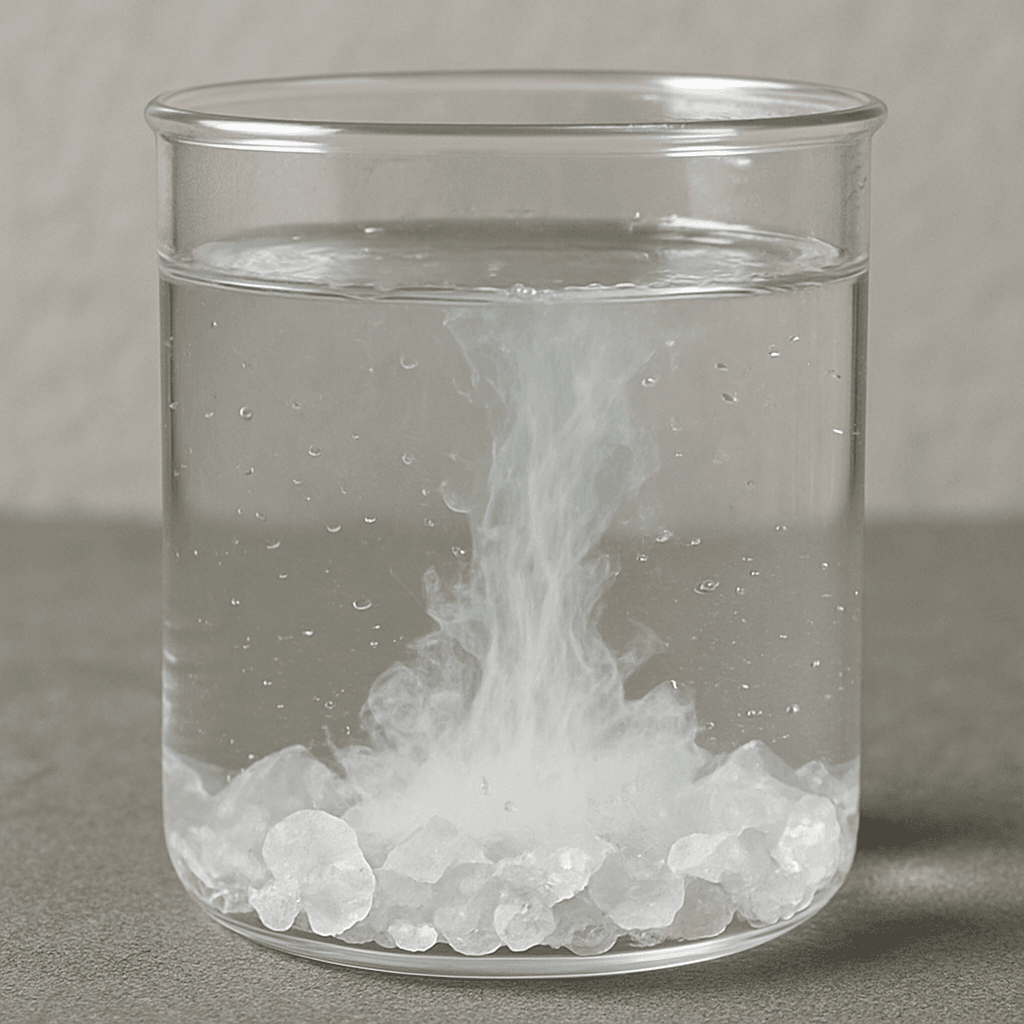
Le nitrate de potassium, souvent désigné par son symbole chimique KNO3, est un composé polyvalent dont les applications s'étendent à l'agriculture, à la conservation des aliments, à la pyrotechnie, etc. Sa caractéristique notable est sa solubilité dans l'eau, une propriété qui joue un rôle crucial dans sa fonctionnalité dans diverses industries. Cet article vise à explorer en détail la solubilité du nitrate de potassium, en examinant ses caractéristiques uniques et ses diverses applications.
Le nitrate de potassium est un composé chimique constitué d'atomes de potassium (K), d'azote (N) et d'oxygène (O). Ce composé se présente généralement sous la forme d'une substance cristalline blanche, connue sous le nom de salpêtre. La nature ionique du nitrate de potassium contribue à sa capacité à se dissoudre dans l'eau, formant une solution qui fait partie intégrante d'un large éventail d'applications.

Oui, le nitrate de potassium est très soluble dans l'eau. Lorsqu'ils sont introduits dans l'eau, les cristaux solides de nitrate de potassium se dissolvent, ce qui permet aux ions potassium et nitrate de se disperser uniformément dans la solution. Cette solubilité est due aux liaisons ioniques au sein du composé, qui sont facilement rompues lorsque les ions positifs de potassium et les ions négatifs de nitrate interagissent avec les molécules d'eau polaires. Cette interaction facilite le processus de dissolution, permettant au composé de devenir une solution homogène.
Caractéristiques de solubilité
Le solubilité du nitrate de potassium dans l'eau est fortement influencée par la température. Lorsque la température augmente, la solubilité du nitrate de potassium augmente, ce qui rend cette caractéristique dépendante de la température. Cela signifie que le chauffage d'une solution peut augmenter sa capacité à dissoudre davantage de nitrate de potassium par rapport à une solution plus froide.
Voici un aperçu détaillé de l'influence de la température sur la solubilité du KNO3 :
- À 0°C, environ 13,3 grammes de nitrate de potassium peuvent être dissous dans 100 grammes d'eau.
- A 20°C, cette solubilité augmente sensiblement pour atteindre environ 31,6 grammes pour 100 grammes d'eau.
- À 60°C, la solubilité atteint environ 108 grammes dans 100 grammes d'eau.
- À 100°C, la solubilité atteint un pic spectaculaire, permettant de dissoudre jusqu'à 246 grammes pour 100 grammes d'eau.
Cette remarquable augmentation de la solubilité avec l'augmentation de la température est essentielle pour son application dans divers processus industriels, améliorant leur efficacité et leur efficience.
Applications pratiques du nitrate de potassium
Utilisations agricoles
En agriculture, le nitrate de potassium est un composant fondamental des engrais. Il constitue une double source d'azote et de potassium, deux éléments nutritifs essentiels pour l'agriculture. une croissance robuste des plantes. En tant qu'engrais soluble dans l'eau, le nitrate de potassium assure la disponibilité immédiate de ces nutriments pour les plantes, ce qui favorise un développement vigoureux et améliore le rendement des cultures. De plus, sa solubilité permet une gestion précise des nutriments, en adaptant les applications d'engrais aux besoins spécifiques des plantes.
Industrie alimentaire
Dans le domaine de la conservation des aliments, le nitrate de potassium est utilisé comme conservateur, en particulier dans la salaison des viandes. Sa solubilité dans l'eau facilite sa pénétration dans les tissus de la viande, où il inhibe la croissance bactérienne. En outre, il préserve la couleur et la saveur des viandes salées, contribuant ainsi à la sécurité et à la qualité des produits alimentaires. Cette capacité à préserver l'intégrité des aliments tout en prolongeant la durée de conservation fait du nitrate de potassium un atout précieux dans l'industrie alimentaire.
Feux d'artifice et pyrotechnie
Les propriétés oxydantes du nitrate de potassium sont exploitées dans la production de feux d'artifice et de produits pyrotechniques. Lorsqu'il est dissous dans l'eau et combiné à d'autres composés chimiques, il joue un rôle essentiel dans la création des couleurs vives et des effets explosifs qui caractérisent les feux d'artifice. Sa solubilité assure une distribution uniforme des composants réactifs, ce qui est crucial pour la réussite des effets pyrotechniques.
Utilisations médicinales
Historiquement, le nitrate de potassium a été utilisé en médecine, notamment pour traiter l'asthme et gérer la pression artérielle. Cependant, avec les progrès de la science médicale, son rôle dans la médecine moderne a diminué, remplacé par des traitements plus avancés et plus efficaces. Malgré cela, son importance historique met en évidence sa polyvalence et l'étendue de ses applications.
Comment le sel de nitrate se dissout-il ?

Le processus de dissolution du nitrate de potassium dans l'eau implique l'interaction entre les molécules d'eau et les ions du sel. L'eau étant une molécule polaire, elle possède des extrémités positives et négatives. Lorsque le nitrate de potassium est introduit dans l'eau, l'extrémité positive des molécules d'eau est attirée par les ions nitrate chargés négativement, tandis que l'extrémité négative est attirée par les ions potassium chargés positivement.
Cette interaction sépare effectivement les ions de la structure cristalline solide, ce qui leur permet de se disperser dans l'eau pour former une solution uniforme. La facilité avec laquelle le nitrate de potassium se dissout souligne son efficacité en tant qu'oxydant soluble dans l'eau, une propriété qui est exploitée dans diverses applications industrielles et scientifiques.
Facteurs affectant la solubilité
Plusieurs facteurs peuvent influencer la solubilité du nitrate de potassium dans l'eau :
Température
Comme indiqué précédemment, la température est un facteur important qui influe sur la solubilité du nitrate de potassium. Des températures plus élevées améliorent généralement la solubilité, permettant la dissolution d'une plus grande quantité du composé, ce qui est particulièrement bénéfique dans les processus industriels où un contrôle précis de la solubilité est essentiel.
Pression
Bien que la pression ait généralement un impact minime sur la solubilité des solides dans les liquides, elle est plus pertinente dans le contexte des gaz. Pour le nitrate de potassium, la pression n'est pas un facteur significatif de sa solubilité, ce qui permet à la température et à d'autres facteurs de jouer un rôle plus important.
Pureté de l'eau
La présence d'impuretés ou de solutés supplémentaires dans l'eau peut affecter la solubilité du nitrate de potassium. Ces substances étrangères peuvent interférer avec le processus de dissolution, réduisant potentiellement la quantité de nitrate de potassium pouvant être dissoute. Par conséquent, l'utilisation d'eau pure est souvent cruciale dans les applications où une solubilité maximale est souhaitée.
Conclusion
La solubilité du nitrate de potassium dans l'eau est une caractéristique déterminante qui sous-tend sa polyvalence et sa vaste gamme d'applications. Qu'il s'agisse de son rôle essentiel dans l'agriculture et la conservation des aliments, de son utilisation en pyrotechnie ou de ses applications médicinales historiques, la capacité du nitrate de potassium à se dissoudre et à interagir avec d'autres substances est essentielle.
Comprendre la solubilité du nitrate de potassium permet non seulement de mieux apprécier ses utilisations pratiques, mais aussi d'ouvrir la voie à des applications innovantes dans diverses industries. Que vous soyez étudiant, professionnel ou simplement curieux de la chimie, la compréhension du concept de solubilité est une étape fondamentale dans l'exploration du monde fascinant des interactions chimiques et de leurs applications dans le monde réel.
 English
 Arabic
 Spanish
 French