
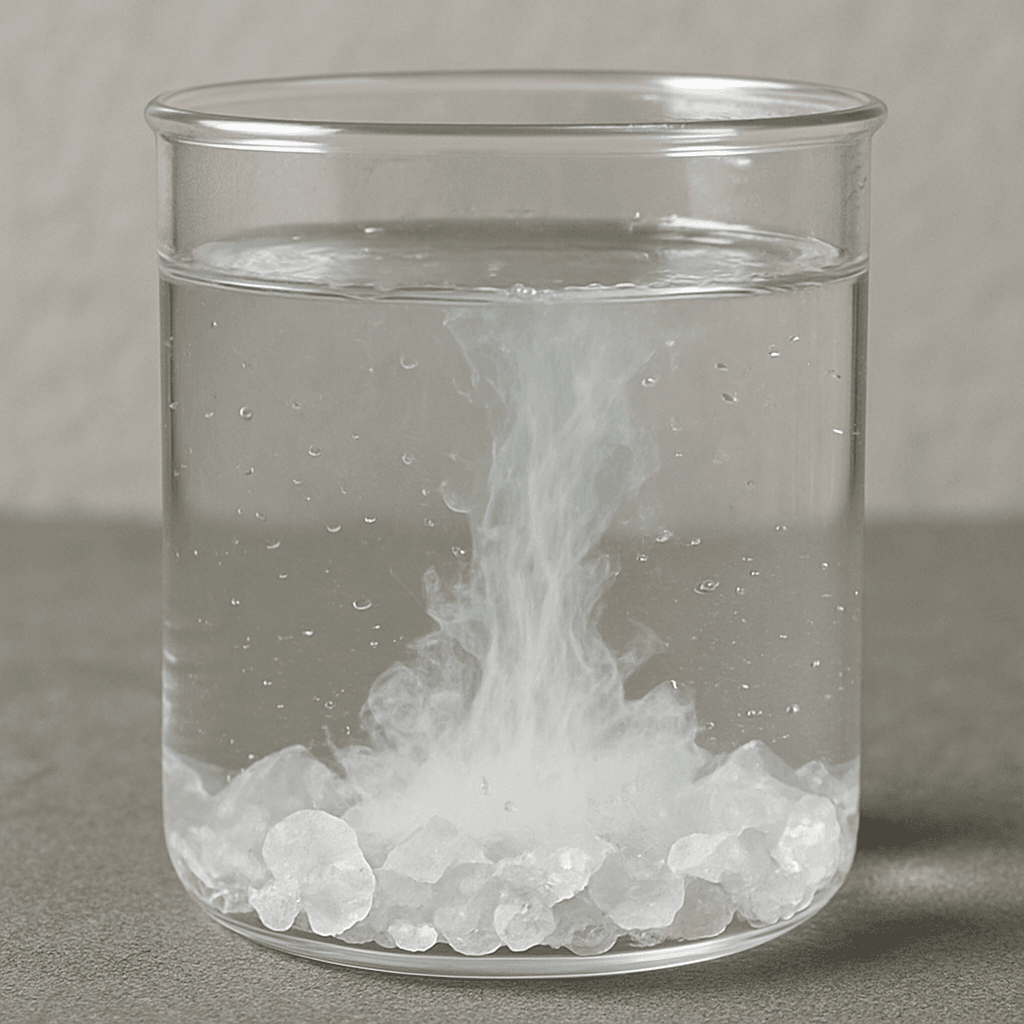
Have you ever marveled at the intricate dance of science hidden in the most mundane substances? Potassium nitrate crystals, often overshadowed by their role in fertilizers and fireworks, hold a captivating secret within their structure—a tale of solubility that’s as intricate as it is enlightening. In this blog post, we delve into the remarkable world of the solubility of potassium nitrate crystals, unveiling the scientific phenomena that govern how and why these crystals dissolve in water across different conditions.
Imagine being able to predict the behavior of a crystal simply by understanding its solubility properties. This knowledge not only satisfies one’s curiosity but also has practical implications in various fields such as agriculture, medicine, and chemical manufacturing. By exploring the factors that affect solubility, including temperature and concentration, we open a door to a realm where chemistry becomes an art form, blending precision with creativity. Join us as we uncover the secrets behind this crystalline compound and gain insights that could revolutionize your perception of everyday materials.

Understanding Solubility: A Gateway to the World of Potassium Nitrate Crystals
Solubility is the measure of how much of a substance can dissolve in a solvent at a given temperature and pressure. When it comes to the solubility of potassium nitrate crystals in water, the interaction is particularly intriguing because it is highly temperature-dependent. At room temperature, only a modest amount of KNO₃ will dissolve, forming a saturated solution. As the temperature rises, the water molecules gain kinetic energy, disrupting the crystal lattice more effectively and allowing more ions to enter the solution.
In practical terms, we classify solutions as unsaturated (where more solute can dissolve), saturated (equilibrium between dissolved and undissolved solute), and supersaturated (holding more solute than normal equilibrium allows). Potassium nitrate is a classic example of a substance that forms supersaturated solutions readily under the right conditions. A hot, concentrated solution can be cooled slowly, and the excess KNO₃ remains in solution until a seed crystal triggers rapid crystallization.
On the molecular level, solubility arises from a balance between lattice energy—the energy keeping ions in a solid structure—and hydration energy—the energy released when ions interact with water molecules. In potassium nitrate, the hydration energy of K⁺ and NO₃⁻ ions is sufficient to overcome the crystal’s lattice energy, especially at elevated temperatures. This balance underscores why temperature is such a crucial factor in the solubility of potassium nitrate crystals.
Exploring this gateway to solubility not only sharpens our understanding of physical chemistry but also paves the way for controlled crystal growth experiments, formulation of chemical products, and innovations in various fields. By mastering how and why potassium nitrate dissolves, scientists and hobbyists alike can harness its properties for practical and educational purposes.
Factors Influencing Solubility: Temperature’s Impact on Dissolving Potassium Nitrate
The solubility of potassium nitrate crystals exhibits a pronounced sensitivity to temperature changes. As the temperature increases, the kinetic energy of water molecules intensifies, allowing them to break apart the rigid ionic lattice of KNO₃ more effectively. This results in a steep solubility curve: a small temperature rise can lead to a significant increase in the amount of potassium nitrate that can dissolve.
Experimentally, the solubility curve for potassium nitrate displays an almost exponential trend between 0 °C and 100 °C. At 20 °C, roughly 32 grams of KNO₃ can dissolve in 100 milliliters of water. By the time the temperature reaches 60 °C, solubility soars to around 109 grams per 100 milliliters. This dramatic change illustrates the endothermic nature of the dissolution process, where heat absorbed from the environment is used to separate ions from the crystal lattice.
Aside from temperature, factors such as agitation, particle size, and the presence of impurities can also influence how quickly and how much potassium nitrate dissolves. Finely ground crystals dissolve more rapidly due to increased surface area. Agitation prevents local saturation and encourages fresh solvent contact. Impurities can either inhibit or facilitate dissolution by altering the crystal’s surface properties.
Understanding these factors in concert allows chemists to design precise experiments and industrial processes. Whether optimizing fertilizer solutions or preparing reagents for laboratory reactions, grasping the temperature dependence and related influences on the solubility of potassium nitrate crystals is essential for consistent, predictable outcomes.
Practical Applications: Utilizing Knowledge of Potassium Nitrate Solubility in Agriculture
Potassium nitrate is a staple fertilizer in agriculture, providing both potassium and nitrogen—two critical macronutrients for plant growth. Its high solubility in water, especially at warmer temperatures, makes it ideal for fertigation systems, where nutrients are delivered through irrigation. By leveraging the solubility of potassium nitrate crystals, farmers can prepare concentrated stock solutions that dissolve quickly and evenly when mixed in irrigation lines.
Accurate control of nutrient concentration ensures that crops receive the right amounts at critical growth stages. For instance, leafy vegetables and fruiting plants often demand more nitrogen during vegetative and fruiting phases, respectively. Dissolution curves inform agronomists about the amount of KNO₃ that can be dissolved at a given temperature, enabling them to adjust stock temperatures or dilution rates for optimal delivery.
Beyond fertigation, sprayer applications also benefit from knowledge of solubility. In cooler climates, the solubility limit at low temperatures must be considered to prevent precipitation within nozzles, which can clog equipment and reduce spray uniformity. Farmers may heat the water slightly or use agitation to maintain KNO₃ in solution until it is applied.
Finally, understanding solubility dynamics aids in minimizing nutrient runoff and environmental impact. Well-dissolved potassium nitrate is less prone to forming solid residues that wash away during heavy rain, reducing the risk of groundwater contamination. Thus, mastering the solubility of potassium nitrate crystals is not just a theoretical exercise—it’s a cornerstone of sustainable, efficient agricultural practice.
Solubility Trends: Observing Patterns in Potassium Nitrate Crystal Dissolution
Careful observation of solubility trends reveals consistent patterns in how potassium nitrate interacts with water. Data collected across a range of temperatures produces a smooth curve that typifies an endothermic dissolution process. Such trends are indispensable in both educational demonstrations and industrial applications, underscoring repeatability and predictability in chemical behavior.
At the onset, solubility increases slowly at lower temperatures, then accelerates sharply above 40 °C. This inflection point highlights the energy threshold needed to overcome lattice forces effectively. Graphing solubility against temperature yields a curve that can be modeled mathematically, allowing chemists to interpolate or extrapolate solubility values without conducting experiments at every point.
Long-term trends also show that repeated crystallization from supersaturated solutions can produce larger, purer crystals. By manipulating cooling rates, one can generate uniform crystals suitable for use in analytical chemistry or as demonstration specimens. Observing how cooling curves correspond to nucleation events provides insight into the kinetics of crystal growth.
Monitoring solubility trends over time can also expose subtle effects of impurities or changes in water quality. Hardness ions, organic contaminants, or dissolved gases may shift solubility limits slightly, making routine trend analysis a valuable quality control measure. Ultimately, these patterns are the blueprint that guides both experimental design and practical utilization of potassium nitrate’s unique properties.
Unveiling the Mysteries: Concluding Thoughts on the Intriguing World of Potassium Nitrate Crystals
The solubility of potassium nitrate crystals offers a profound glimpse into the balance of forces at play within ionic compounds. From the fundamental principles of lattice energy and hydration to the practical demands of agriculture and industry, this single property connects theory with real-world application.
By mastering solubility trends, temperature effects, and dissolution dynamics, we unlock new possibilities for efficient fertilizer delivery, controlled crystallization experiments, and sustainable chemical processes. The elegance of potassium nitrate’s behavior reminds us that even common substances can harbor extraordinary scientific stories.
 English
 Arabic
 Spanish
 French